
Massachusetts must stop mistreatment of people with mental illness
Reposted from CommonWealth Beacon May, 13, 2024 by Summer Maxwell
The report released in March condemning Bridgewater State Hospital —Massachusetts’s state psychiatric facility — felt more like a broken record than a revelation. The 87-page document outlined issues that have plagued the facility for years, including allegedly illegal practices used to restrain and seclude prisoners and potentially lethal health risks, including exposure to mold, asbestos, and brutally hot temperatures.
Though disturbing, I can assure you the report is no exaggeration. I spent a day inside Bridgewater in August 2022 while serving as an intern for state Sen. Jamie Eldridge, who chairs the Massachusetts Legislature’s Criminal Justice Reform Caucus. I asked to accompany the senator on a tour of Bridgewater for lawmakers, and was tasked with observing what I could to gather information on conditions at the facility.
What I saw with my own eyes was nauseating. The sickening heat, the chemical smell, the damp and mold-coated bathrooms. The men calling out to me as I walked the halls, asking me to help them, with fear and desperation in their voices.
The Disability Law Center, which released the recent report, has been advocating for better conditions at Bridgewater for over a decade. The organization observes the facility and continuously calls for action to address the dubious practices perpetuated by the Department of Correction, which maintains oversight of the hospital, and its private health care contractor, Wellpath Recovery Solutions.
Wellpath has a notorious reputation, including being sued over 1,000 times in federal court for poor or wrongful patient care across the country. Wellpath’s contract with Bridgewater was set to expire in June, yet in March the DOC quietly revealed that it has extended the partnership until June 2025.
The state announced on Friday that Wellpath’s contract will not be renewed and it will be replaced by another private health care provider at 10 state correctional facilities. However, Bridgewater was excluded from the shift, and instead remains under contract with Wellpath until at least mid-2025. The change in providers demonstrates the state’s willingness to cut Wellpath loose, but the fact that it doesn’t extend to Bridgewater is troubling, considering it houses the DOC’s most vulnerable patient population. If Wellpath isn’t good enough for the rest of the state’s incarcerated population, why is it determined sufficient for Bridgewater?
In an attempt to address concerns, Gov. Maura Healey allocated funds in her Five-Year Capital Investments Plan to create a “long-term strategy for Bridgewater State Hospital” and complete a study on the potential development of a new psychiatric hospital under the Department of Mental Health.
While the governor’s plan is a good step, the men being served at Bridgewater cannot wait years while being exposed to potentially illegal treatment and health-hazardous conditions until policies are changed.
Instead, the state must act to rebuild Bridgewater and move it under the jurisdiction of the Department of Mental Health to ensure those inside get the psychiatric treatment they need.
We are at a unique crossroads to break the cycle of governmental inaction on the issue. There is already legislation introduced on Beacon Hill to move oversight of Bridgewater to the Department of Mental Health — H.2985 and S.1239.
Similar bills have been introduced to every legislative session since 2017, but none have ever passed. Yet Healey has proved herself to be ready to take decisive action on issues involving the DOC — most notably, the surprise closure of MCI-Concord announced in January.
With proposed legislation pending and an ambitious freshman governor in office, now is the time to act.
My own visit to Bridgewater State Hospital made clear to me that no compassionate, effective psychiatric treatment can occur at a facility run by a carceral body designed to punish and a private contractor with a national reputation for negligence.
The March report spelled out what I saw by outlining a slew of alleged misconduct, stating that the “DOC and Wellpath have employed policies and practices that subject [persons served] to medication absent emergency circumstances in violation of Massachusetts law.”
The review also claimed that security staff at the facility used riot gear to force administration of medication. In addition, the document states that the DOC has made little effort to reduce mold, the presence of asbestos, and extreme heat, as has been recommended for years.
It is alarming to read the report and see how little has changed since I visited over a year ago.
To be sure, the Healey administration will not want to risk looking soft on crime by authorizing a release of individuals from the DOC to the Department of Mental Health. But no one at Bridgewater has ever been convicted of a crime. Rather, they are civilly committed without criminal sentences, awaiting pre-trial evaluation, or found not guilty by insanity.
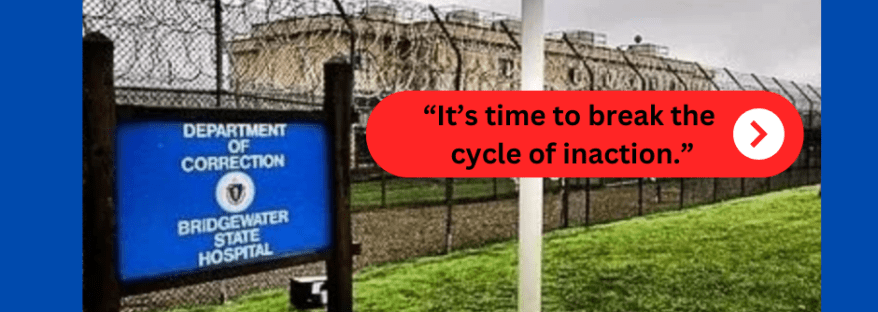
It’s time to break the cycle of inaction. Beacon Hill must pass the legislation to transfer the oversight of Bridgewater to the Department of Mental Health immediately, and the governor must commit to building a new facility to house Bridgewater patients and ending Wellpath’s contract.
I fear that a failure to make use of the opportunity before us to ensure quality care for those at Bridgewater today will spell a lifetime of health risks and abuse for those inside.
Summer Maxwell is a senior at Tufts University majoring in political science. She served as an intern in 2022 for state Sen. Jamie Eldridge.

 Family and Friends of Individuals with Mental Illness ~ Advocating for those who are Justice Involved